
Plumbing & Heating Advice
Expert tips, maintenance guides, and industry insights to help you keep your home warm, efficient, and running smoothly.

6 Reasons Why You Should Get Your Boiler Serviced Annually
If you’ve ever wondered why you need an annual boiler service, here are six vital reasons.
Have you had your boiler serviced in the last 12 months? It’s a job on our to-do list that is so easily forgotten about or put off. But annual maintenance is vital to keep your boiler working efficiently and safely. If you’re unsure why you even need a boiler service, here are 6 important reasons.

1. Spot Issues Before Your Boiler Breaks Down
There could be small issues building up in your boiler without you even knowing about it. It isn’t until you start using your boiler more in the winter months that issues become more apparent.
By having your boiler serviced every year, these small issues will be spotted early and fixed before they become bigger issues. The last thing you want is a costly boiler breakdown.
2. Avoid Replacing Your Boiler
If your boiler does break down and it’s not fixable, you’ll have to get a new boiler installed. This is an expensive outlay that could have been avoided with regular maintenance. On the other hand, an annual service will cost you just £50+VAT which is a relatively small annual expense.
3. Save Money on Energy Bills
When your boiler is running as efficiently as possible, it will help ensure your energy bills stay in check. When your boiler is struggling, more energy is eaten up to heat your water, so you might see your monthly bills slowly creeping up.
As part of your annual service, we’ll ensure your boiler is running efficiently, which will help you cut your energy bills and save you money over time.
4. Keep Your Family Safe
Each year, 4000 people are admitted to A&E with carbon monoxide poisoning. The symptoms are common so often confused with other illnesses, making CO poisoning a seriously harmful condition.
A regular boiler service will give you the peace of mind that your boiler isn’t producing harmful levels of carbon monoxide. To be safe all year round, make sure you also have a carbon monoxide detector near your boiler.
5. Keep Your Warranty Valid
Most boiler warranties include a condition that mandates an annual boiler service. If you don’t get a service from a Gas Safe registered engineer, your warranty may become void which is a headache if you experience a major fault or breakdown during the warranty period.
Book a yearly service to keep your warranty valid so you don’t get caught out while under the warranty period.
6. It's the Law if You’re a Landlord
This one is only relevant if you’re a landlord. All landlords are legally required to get an annual gas safety check on any rented properties. This will include a boiler service, but your plumber will also check all gas appliances, pipework and flues.
A landlord gas safety check is a slightly different process, so if you’re a Landlord make sure to book in your annual check now.
Do You Need a Boiler Service in Bristol, Chepstow or Monmouthshire?
If you haven’t had your boiler serviced in the past 12 months, now is the time to book in a service. At Coolheat Plumbing, we offer boiler services in Bristol, Chepstow, Monmouthshire and all surrounding areas.
Call us today to book an appointment that suits you.

Bathroom Installation: Your Complete Guide
Thinking about a bathroom installation in Bristol or South Wales? Read our full guide to find out everything you need to know about bathroom renovations from the average cost to some of our top tips.
Do you loathe going into your bathroom each morning? Maybe it’s just not functional for your family anymore or it’s dated and could do with an update. A bathroom installation is a relatively easy project that can update the space, make it significantly more functional, and add value to your home.
If you’re thinking about a bathroom renovation in Bristol or South Wales but have no idea where to start, our guide will give you everything you need to know.
How Much Does a Bathroom Installation Cost?
Overall, the average cost of installing a new bathroom in the UK is £4,500. However, if you’re simply swapping a like-for-like suite, without additional tiling or flooring, you may be able to achieve this for as little as £1,500.
The cost varies depending on the quality of fixtures you go for. You can pick up a bathroom suite for as little as £200. However, if you decide to opt for something higher quality, it will cost more.
Tiles are another element of a bathroom remodel that can drastically up the cost. High-end tiles can be expensive, and you’ll have to pay around £65 per square metre for a professional tiler.
Your Free Quote for Bathroom Installations in Bristol & South Wales
If you’re thinking about a bathroom renovation but you have no idea how much it will cost, give us a call. We’ll come out to give you a free no-obligation quote!
How to Plan Your Bathroom Layout
Are you planning on keeping your bathroom suite in the same position? Or would a different layout be best? Here are some tips to keep in mind:
Positioning Your Toilet
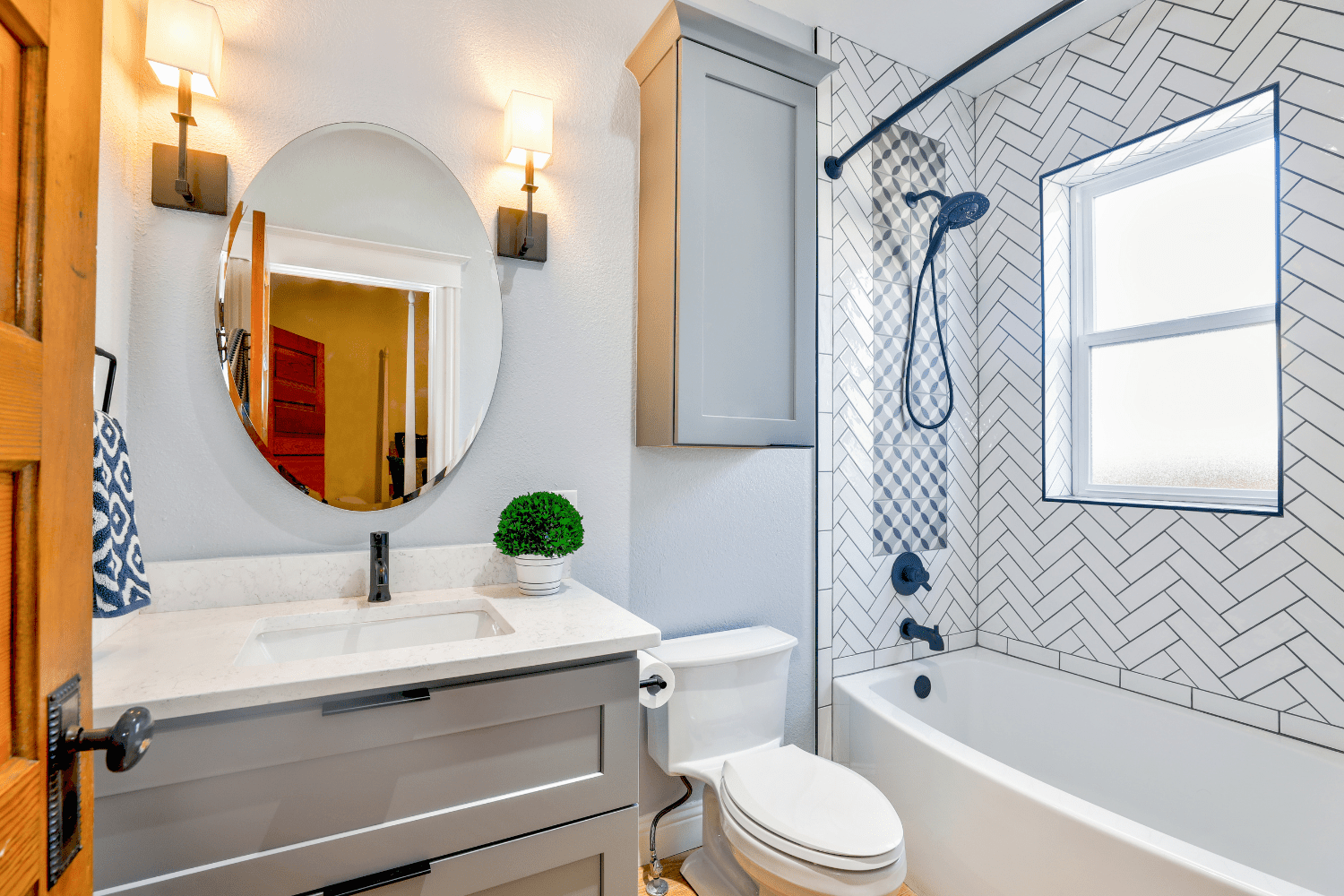
One of the very first things to consider is the position of your toilet. This is usually dictated by your soil pipe. In most cases, it will be much easier to fit your toilet where the soil pipe exits the room, rather than considering a different layout.
Decide on Your Fixtures
You should decide on your bathroom fixtures early in the process. For example, if you’d like a double shower to replace your single shower, you’ll need to make sure there’s enough space.
Likewise, if you want a new wall-hung vanity, the wall may need to be strengthened during the build process.
Choosing your products early in the process will make the rest of the project much smoother.
The Shower
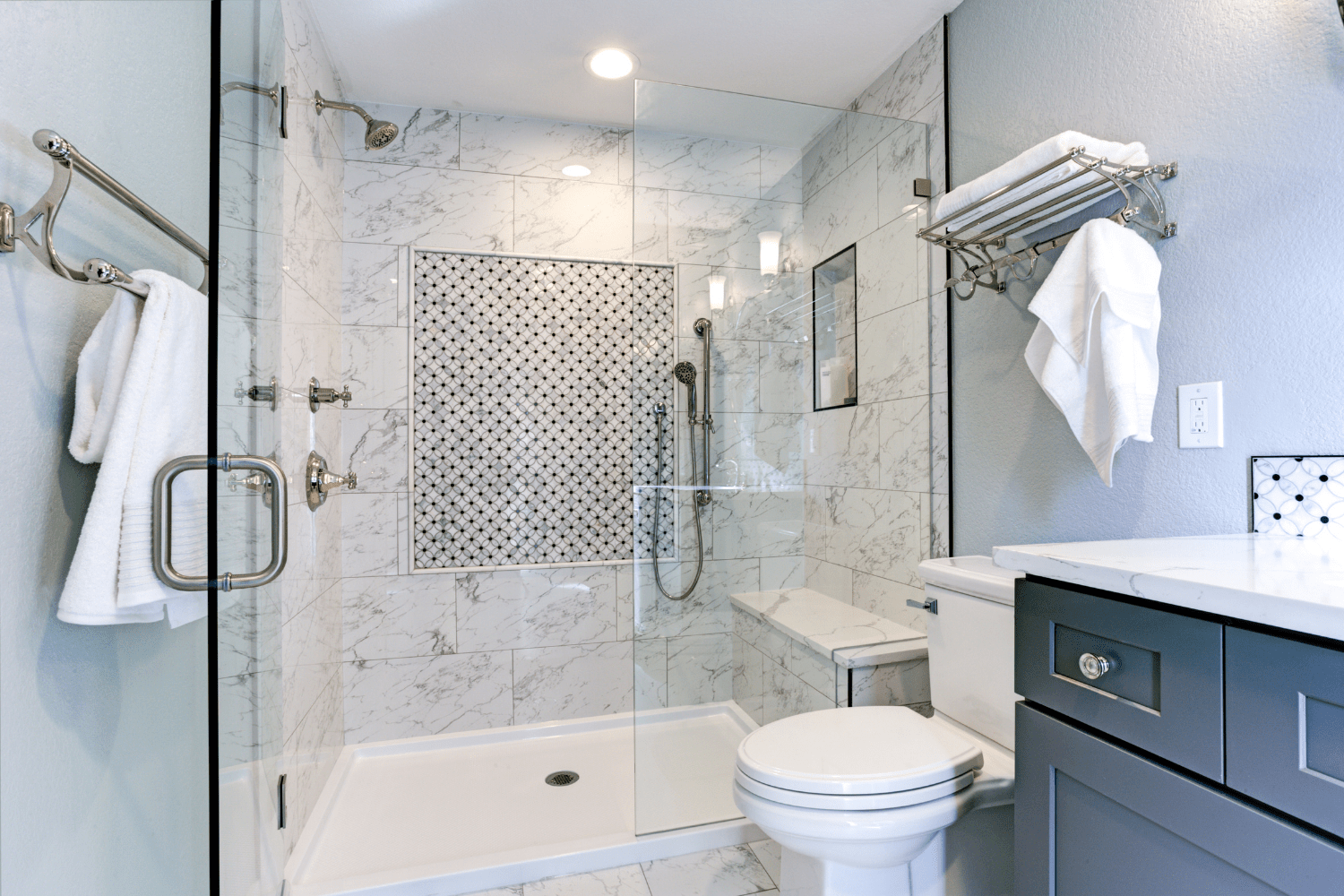
If you’re having a shower cubicle, make sure you think about the spacing around it. Do you have enough clearance for a hinged door? Or will you need a sliding door?
Corner units are a good way to save space and these come with sliding doors which don’t need any clearance.
Another thing to keep in mind is your towel rail. You don’t want to design your shower door to open up onto the other side of the bathroom nowhere near your towels.
Walking Space
If you plan on adding in a larger bathtub or a double shower where you currently have a single, make sure there is enough walking space to get around with ease.
You need a minimum of 21 inches between all fixtures to meet code. However, we recommend 30 inches to give a comfortable amount of walking space.
To check this, head to your bathroom with a tape measure and mark out the new fixtures with some tape to get a good idea of how much space you’ll have left.
Ventilation
This is often forgotten when designing a bathroom, but good ventilation is key. Even if you have a window in your bathroom, It’s best to have an extractor fan to remove excess moisture. This will help prevent mould and damp building up.
An extractor fan can be installed either in the wall or ceiling. If you have spotlights in your bathroom already, one light can be swapped out with an extractor fan/light combo fairly easily.
Lighting
The lighting in your bathroom is important. Do you want bright light to make getting ready in the morning easier? Or would you like soft light to give a peaceful atmosphere when taking a long bath?
You need to know what kind of lighting you’d like and factor this into your layout.
Are you going to have spotlights installed for a bright, modern finish? Or perhaps you’d like a large mirror with backlighting? This is down to personal preference but it’s best to have an idea before any work starts.

How Long Does It Take to Install a New Bathroom?
The quickest, easiest way to get a bathroom installed is to hire a turnkey provider, like us.
At Coolheat Plumbing, we take care of everything needed for your bathroom renovation. This includes relocating fixtures, pipework, tilework, plastering, and tiling, as needed.
This is much quicker than hiring individuals to do each job and gives a much higher quality finish than going down the DIY route.
When you hire a professional firm to take care of your bathroom installation, it should take an average of two to four weeks for a full bathroom renovation.
However, this will vary depending on the size of the bathroom and level of work needed.
Bathroom Installation Process
So you may be wondering, what is the process when I hire a bathroom contractor to install a new bathroom? Let’s take a look at the steps involved:
1. Removal of the Old Suite
After the water has been turned off, your existing bathroom fixtures will be removed. This includes the sink, shower enclosure, shower tray, toilet and bathtub.
2. Tile Removal
Next, all tile is removed and the damage beneath assessed. If the tiles come off easily, they may not cause a lot of damage and tiles may be able to be added to the existing plaster. However, the tile will likely damage the wall underneath, in which case the plasterboard will be pull down too.
3. Electrics
If you’re having underfloor heating, new lighting or a digital thermostat, the electrics will be done at this point. All wiring will be run as needed and holes will be drilled in the ceiling for ceiling lights if needed. The extractor fan will also be installed at this stage.
4. New Pipework
New pipework will be needed if you want to move the location of your fixtures or if your current pipes are corroded or not up to code.
This is why it is vital to know which fixtures you’re having beforehand. For example, a floating vanity will require new pipework and reinforcement of the wall where it will hang before it can be installed.
Likewise, a bath with centred taps will need different pipework than a bath with taps at the end.

5. Wall Preparation
Now all the prep work has been done, new plasterboard can be installed. This is professional-grade, water-resistant plasterboard that will stop damp.
6. Painting
Although we don’t offer painting services, now would be a good time to paint the room before your new fixtures are installed. That way, you don’t have to worry about paint splashing on your new bathroom suite or new tiles.
7. Suite Installation
Next, your new bathroom suite will be installed. This will include a new toilet, basin, bathtub and/or shower tray and enclosure.
8. Tiling
Finally, your walls and floors will be professionally tiled to give a fantastic finish. If you’re having underfloor heating, the cable network will be laid and tested before tiling the floor to make sure it’s working.
9. Electrics
The last step is hooking up any electrics such as the underfloor heating thermostat, spotlights, extractor fan, or shaver socket. This will be done by a registered electrician.
How to Save Money on a Bathroom Renovation
1. Keep fixtures where they are
If your bathroom already functions well, you’ll save a good chunk of your budget by leaving all your fixtures in the same place. Relocating a waste pipe for a toilet is a big job which will add days to the job. Overall, the more fixtures you move, the more pipework that needs to be run, the higher the cost.
2. Opt for Shower boards instead of tile
Shower boards are less expensive than tile and are much easier to maintain since there are no grout lines to scrub.
They come in a range of colours and look fantastic in a new renovation, so they don’t feel like a compromise.
3. Do the prep work yourself
If you’re happy with DIY, you’ll save labour costs by removing tile yourself. However, make sure you wear thick gloves and safety goggles. Tile shards can be extremely sharp when chipping off a wall.
If you plan on removing your old suite yourself, make sure you turn the water off and drain your system first.
4. Get Our Advice on Fixtures
If you have a set budget in mind, we’ll be able to give you our expert advice on the best fixtures that not only look great but fit within your budget.
We use City Plumbing as our supplier. They offer a great range of fixtures to suit all budgets. They also have up to date trends to help you get a modern look.
Bathroom Inspiration
We couldn’t end this guide without some inspiration to help you visualise your new bathroom. Here are some photos of our recent projects.
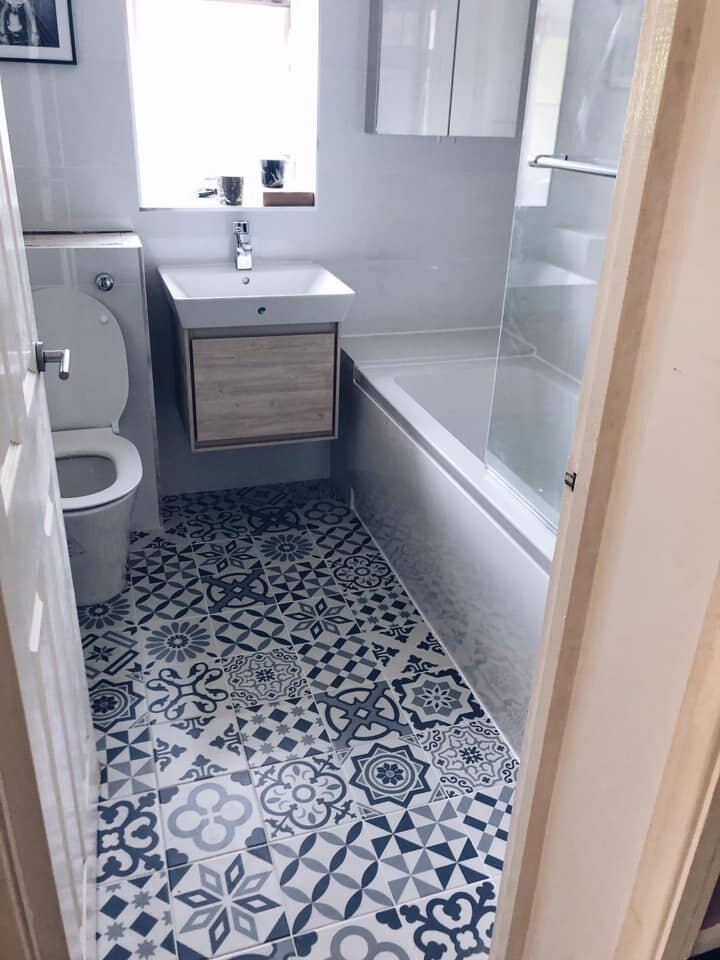
This bathroom features gorgeous victorian-style patterned tile and a floating wood vanity that give a timeless look.

This luxurious bathroom has a deep soaker tub with standing faucet which gives a boutique hotel finish.

This bright and modern bathroom was large enough for a deep tub, double shower and floating vanity. We had a slim toilet which fits snuggly in the corner, but still has plenty of room to make the entire space feel airy.
Looking for a Bathroom Installation in Bristol or South Wales?
At Coolheat Plumbing, we offer a turnkey bathroom installation service. We take care of everything from laying all new pipework right through to professional tiling and electrical work to take the stress of a bathroom renovation off your shoulders.
Give us a call today to get a free no-obligation quote and we’ll give you our expert advice on how to get the most out of your bathroom.

How-To Series: How to Bleed a Radiator
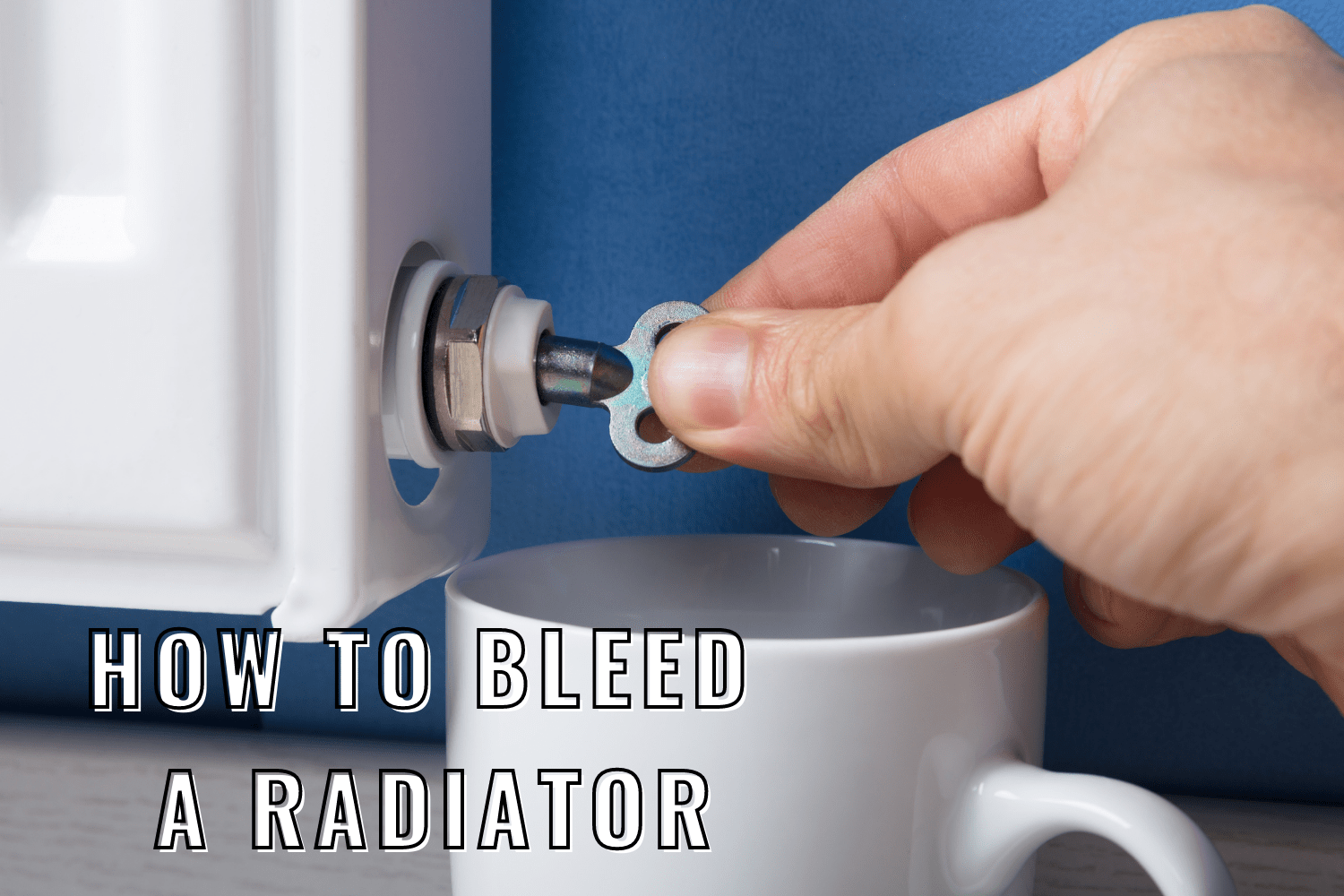
Are your radiators not heating up properly? You probably need to bleed your radiators. This guide will show you the easy step-by-step process for how to bleed a radiator without the need of a plumber!
Do your radiators constantly have cold patches? And have you heard loud clanking or banging coming from your pipes? If so, your radiators probably need bleeding. This is something you should do at least once a year, but if you’re experiencing problems, you should do it right away. Not sure how to bleed a radiator? This guide will take you through the simple process!
Why Do You Need to Bleed a Radiator?
We bleed radiators to release any trapped air from the heating system. This trapped air stops the hot water circulating properly which reduces the efficiency of your heating system.
If you have trapped air in your system, your radiators won’t heat up properly and you’ll start to hear that irritating banging noise in your pipes.
How to Bleed a Radiator
The good thing is you don’t need to call out a plumber to bleed your radiators. It’s a simple process you can do at home with just a couple of tools:
Radiator key (these can be picked up at any tool store such as B&Q for £1-£3)
A towel
A container
1. Turn off your boiler
If you bleed a radiator while the boiler is on, you risk hot water gushing from your pipes when you open the radiator valve.
2. Start at the bottom
You’ll need to bleed all of the radiators in your home for maximum effect. Start with the lowest one in your home that is the furthest from the boiler. Then go to the next-furthest and so on until you’ve done all of the radiators on the lowest level.
When you move upstairs, start with the furthest from your boiler. If you have multiple levels, keep periodically moving up until you’ve reached the highest radiator.
3. Bleed the Radiator
Insert your radiator key into the valve on the side of the radiator. Hold your towel under the valve to catch any water that comes out. Turn it very slowly anti-clockwise until you hear a hissing sound. This is the air escaping from the radiator.
Hold the key and towel in place until the hissing stops. Once it stops, you should get a small trickle of water coming out. Once you see this water, turn the valve clockwise to close it. Make sure it’s secure so no water comes out.
If you’re worried about a lot of water coming from the radiator, you can put the container on the floor underneath the valve to catch any extra water that you miss with your towel.
Repeat this process for each radiator in your home.
4. Check Your Radiators are Heating Evenly
Once you’ve done all the radiators and the valves are all safely closed, turn your heating on to check the radiators are heating evenly. Make sure you go around and inspect each radiator to ensure there are no leaks from any of the vales.
If they are still not heating evenly, you may need to repeat the bleeding process. There may still be air trapped in the system.
Need a Plumber?
If you’ve bled all of your radiators but you’re still experiencing issues, give us a call! We’re professional plumbers in Caldicot who cover the entire South Wales region as well as Bristol. We’ll come out, take a look at your system, and give you a free quote for any repairs needed.

How to Choose the Right Boiler for Your Home
Thinking about getting a new boiler installed? This guide will show you how to choose the best boiler for your home.
Has your boiler seen better days? Although a good quality boiler can last for years, there comes a time when your boiler will need to be replaced with a new, high-efficiency model. If you’re thinking of getting your boiler replaced, this guide will show you how to choose the best one for your home.

Boiler Types
There are three main types of boiler:
Combination (combi)
Regular
System
The best one for you will depend on the needs of your household. Combi boiler are smaller and provide instant hot water. On the other hand, System boilers require a hot water cylinder for storing hot water. Finally, regular boilers require a cold water tank and are usually found in homes with a traditional heating system.
Most heating engineers will usually reccommend a combi boiler since this one is the most compact and offers instant hot water.
Fuel Types
All three boiler types are available in gas, LPG (liquefied petroleum gas) and oil variants.
Gas boilers usually cost less to operate than oil boilers. However, the fuel type you choose will be dictated by what’s available in your area.
This is something your gas safe engineer will be able to advise on.
Output
The ‘size’ of a boiler refers to the power output measured in kilowatts. Generally, the larger the kilowatt output the more demanding your heating and hot water requirements tend to be.
Boilers range from 9 to 50 kilowatts. The size needed will depend on the size of your house, number of bathrooms, and the demand for hot water.
If you find that water often goes cold in your home, you made need a larger boiler to meet your needs.
Hot Water Demand
Combi boilers provide hot water and heating on demand from the mains water supply. However, if you have a large family or multiple bathrooms, a combi may struggle to provide enough hot water.
In this case, a regular or system boiler may be a better match. Again, your plumber will be able to give you expert advice on which boiler is the best based on your home and usage.
Oversizing
Based on this, you might think it’s best to get an oversized boiler to ensure you always have hot water. However, there really is no benefit of oversizing your boiler. In fact, it may make your energy bills more expensive unnecesarily.
This is why it’s important to ensure you have the right type and size of boiler for your home.
Looking for Expert Boiler Installation?
Need a boiler quote in Bristol or South Wales? Give our team a call today. We will be able to come out and give you a free quote and advice on the best boiler for your home.
If you’ve ever wondered why you need an annual boiler service, here are six vital reasons.